Why Your Pain Won't Go Away — Inflammation, Nerve Pain & What Your Body Is Actually Telling You
What Your Body Is Actually Telling You When Pain Won't Go Away
Most people think pain equals inflammation. It's an easy assumption to make — you get hurt, things swell up, it hurts. But that's actually only one small piece of a much bigger picture. And for a lot of people dealing with lingering pain that just won't quit, inflammation isn't even the issue anymore.
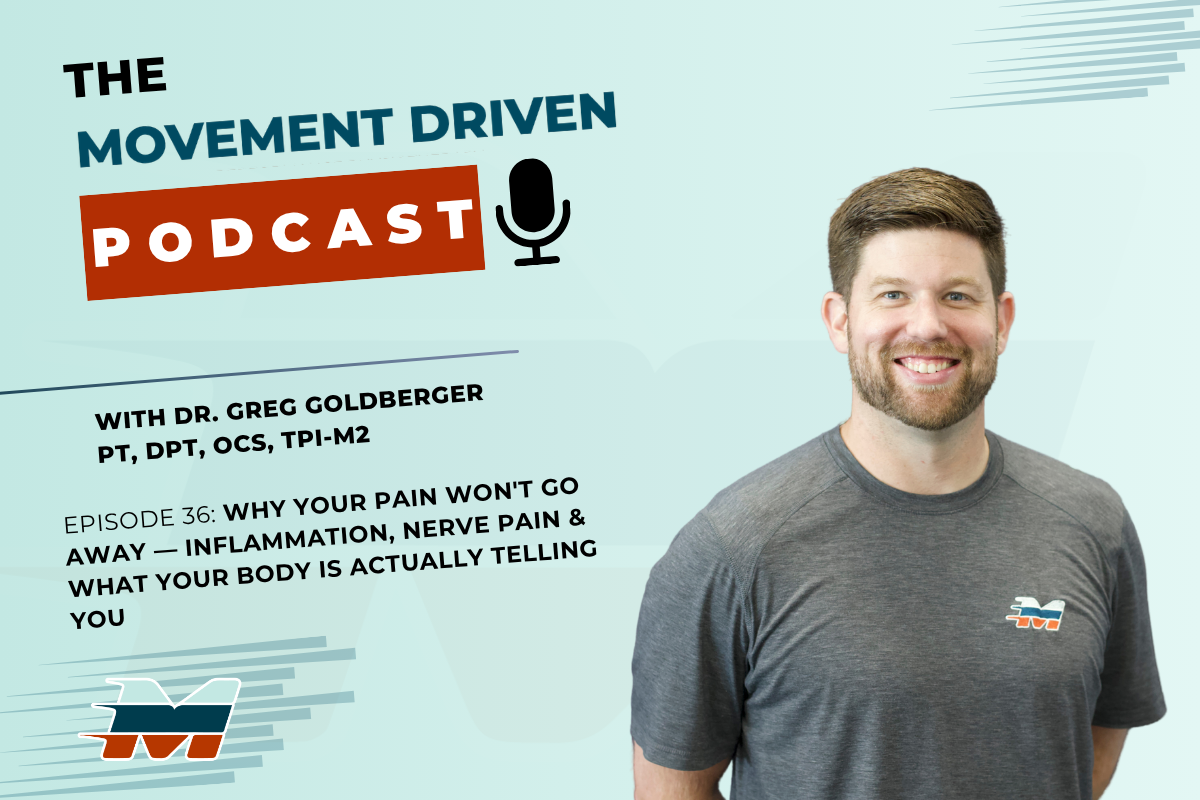
Dr. Greg Goldberger has this conversation with patients regularly. In this episode of the Movement Driven Podcast, he breaks down why inflammation gets such a bad rap, what the different types of pain actually are, and why treating the wrong one is exactly why so many people stay stuck.
Inflammation Isn't the Enemy
Here's the thing most people get backward: inflammation is necessary. It's your body's built-in response to damage — it brings the right cells to the area to clean things up and start the healing process. Without it, you don't heal.
The problem isn't inflammation itself. It's when inflammation either overstays its welcome or gets blamed for pain that it's no longer responsible for.
In a typical soft tissue injury, the inflammatory phase runs about zero to five days. After that, the body moves into a proliferation phase — tissue rebuilding — which can last several more weeks. Then comes remodeling, where collagen lays down and tissues become more resilient. That phase can run two to three months depending on the injury.
So if you sprained your ankle and you're still hurting at the six-month mark? That's not inflammation. Something else is going on.
The 5 Types of Pain — and Why It Matters Which One You Have
This might be the most important thing you take away from this episode. Pain isn't one thing. There are actually several distinct types, and treating the wrong one is one of the main reasons people don't get better.
Inflammatory pain is what most people picture. Swelling, redness, heat, discomfort at rest. This is appropriate in the early stages of injury, but it shouldn't be your long-term reality.
Ischemic pain is far more common in chronic cases than most people realize. This is pain driven by restricted blood flow — that deep aching spasm in your low back after a long day, or knee soreness that actually loosens up after foam rolling. When movement or soft tissue work makes you feel noticeably better within minutes, you're likely dealing with ischemic pain, not inflammation.
Mechanical pain is positional. It shows up when a joint isn't moving well and certain movements create compression or pinching on a tissue. This isn't about inflammation at rest — it's about what happens when load goes through a system that isn't moving the way it's supposed to.
Neuropathic pain is nerve-driven — the burning, shooting, tingling, or hard-to-pinpoint discomfort that people with sciatica know all too well. It can overlap with other pain types, but it requires a completely different treatment approach.
Central sensitization is the one that gets overlooked the most. After months or years of pain, the nervous system itself can become sensitized — meaning the threshold for feeling pain drops significantly. Stress, sleep disruption, and the psychological weight of chronic pain all feed into it. At this point, doing more exercises or stretches alone won't fix it. How you understand and expect pain has to be part of the equation.
Most people dealing with chronic pain have more than one of these happening at the same time. That overlap is exactly why a generic protocol rarely works.
Why Pain Sticks Around
When someone comes to see Dr. Greg months after an injury, they're almost never still in an inflammatory phase. What they're dealing with is the snowball effect.
It usually starts with rest — which feels like the right call but often goes on too long. Tissue weakens. Range of motion drops. The body starts compensating. New movement patterns form to protect the original injury. And now there are two problems: the initial injury
and a layer of compensations built on top of it.
Early intervention matters more than most people think. Catching something in that first week or two often means one or two visits to get things back on track. Waiting months means more visits, more work, and more to unwind.
The system isn't designed to help with that. Insurance protocols are built around average soft tissue healing timelines — four to six weeks — not around actually getting someone back to full function. The goal at Movement Driven is different: fewer visits spread over a longer timeline, building genuine strength and resilience rather than just managing pain until the coverage runs out.
What About Anti-Inflammatories and Injections?
They have their place. If inflammation is severe enough that it's preventing movement entirely, a corticosteroid shot or anti-inflammatory medication can create enough of a window to actually do the work. The problem is when they become the whole plan.
Managing a symptom isn't the same as fixing what's causing it. If the underlying mechanics, movement patterns, or tissue health don't change, the pain comes back. These tools work best when they're paired with active rehabilitation — not used as a substitute for it.
The Bottom Line
Pain always has a reason. It's not random, and it's not something you just have to live with. But figuring out which type of pain you're dealing with — and why — is what separates treatment that actually works from treatment that just keeps you going in circles.
If you've been in pain for months and feel like nothing has really addressed it, it might be because no one has taken the time to listen closely enough to figure out what they're actually treating.
📍 If you're in the Jacksonville area and ready to get to the root of it, book a free 15-minute discovery call or schedule your first evaluation for $79 at movementdriven.com. You'll get a full movement assessment and a plan built around your body — not a generic protocol.
🎧 Listen to the full episode on
Spotify,
Apple Podcasts, or
YouTube.