
Spring Baseball, Golf Season, and Pickleball Leagues Are Starting — Is Your Body Ready?
Greg Goldberger • March 23, 2026
Spring in Northeast Florida means full schedules are back — and so are the preventable injuries. Here are the three mistakes Dr. Greg sees every year, and how to avoid them.

Spring in Northeast Florida is one of my favorite times of year — and not just because the weather turns perfect. It is the time when my phone starts ringing with a very specific kind of patient.
The golfer who took December and January mostly off, played a few casual rounds in February, and is now heading into a full spring schedule. The pickleball player whose league just started back up. The baseball parent whose kid is back in full practice mode — and who is, themselves, coaching and throwing more than their shoulder has seen in months.
Every year, I see a wave of spring injuries that were almost entirely preventable.
The body does not care that it's officially spring. It only knows what you've been asking it to do — and what you haven't.
Here are the three most common mistakes I see active adults make as they ramp back up for spring, and how to avoid them.
Mistake 1: Skipping the Mobility Work
If you have been less active over the winter — fewer rounds, shorter runs, lighter lifting — your mobility has probably taken a hit. Hips get tighter. Thoracic spine loses rotation. Ankles stiffen up.
None of that is immediately obvious when you feel fine standing in your kitchen. It becomes obvious the third time you feel a sharp pull in your lower back mid-backswing, or the morning after your first full pickleball session when your Achilles is screaming.
The fix is not complicated, but it requires intention. Ten to fifteen minutes of targeted mobility work — hips, thoracic spine, ankles — done consistently before activity is genuinely protective. Not the generic stretching you did in high school. Movement-specific preparation that matches what you are about to go do.
If you are not sure what that looks like for your sport and your body, that is exactly the kind of thing we can map out in a single session.
Mistake 2: Skipping Progressive Loading
Your body adapts to the loads you place on it. When those loads decrease over the winter and then suddenly spike in the spring, the tissues that handle force — tendons, in particular — are the first to protest.
Golfer's elbow, rotator cuff irritation, patellar tendon pain, plantar fasciitis — these are classic spring overload injuries. They are not bad luck. They are a mismatch between what the tissue is conditioned to handle and what you are suddenly asking of it.
The principle of progressive loading is simple: increase your volume and intensity gradually. Do not go from two casual rounds per month to five rounds per week overnight. Do not jump straight into full-speed pitching. Build the tissue back up before you ask it to perform.
A good benchmark: increase your total training load by no more than 10 percent per week. It feels slow. It works.
Mistake 3: Under-Fueling the Ramp-Up (This One Is Especially Important in March)
Since we are in Nutrition Month, I want to make sure this one gets its due attention, because it is the most underestimated spring mistake I see.
As your activity level increases in the spring, your nutritional demands increase with it. Your protein needs go up. Your hydration requirements increase significantly in Florida's warming weather. Your body needs more fuel to support both performance and the tissue repair that happens every time you play.
The mistake I see most often: people maintain their winter-level eating habits while dramatically increasing activity. The caloric and protein gap that creates is a direct recipe for fatigue, slow recovery, and increased injury risk.
Revisit your protein intake. Target 0.7 to 1.0 grams per pound of body weight. Get something with 20 to 30 grams of protein in within an hour after activity. Pay attention to how much water you are actually drinking now that it is warmer. These are not complicated changes, but they make a significant difference in how your body responds to increased demand.
A Simple Self-Assessment Before Your Season Starts
Before you ramp up fully, run through these quick checks:
- Can you rotate your thoracic spine symmetrically? Reach both arms overhead without significant compensation? A limited yes here is your first red flag.
- Do you have any lingering discomfort from last fall that you never fully addressed? Those 'almost healed' things have a way of becoming real problems when volume goes up.
- Have you been moving consistently enough to handle the demands of your sport, or is this a significant jump in activity?
- Are you eating and hydrating to support what you're about to ask of your body?
If any of those answers made you pause, now is the best time to address it — before the season is in full swing and missing games or rounds becomes the cost of ignoring it.
Spring in St. Johns County is too good to spend on the sideline. A little investment in preparation goes a long way.
➤ Want a movement screen before your season starts? Reach out
to schedule your evaluation with Dr. Greg — spots fill fast in spring.

Learn what the research actually says about safely increasing weekly mileage — and where the 10% rule falls short.

Movement Driven answers a common question from Jacksonville and St. Johns County parents. Here's what it actually checks for.
Learn the difference between tennis elbow and golfer’s elbow, common causes of elbow pain, and why treating the source matters with Dr. Greg Goldberger.

See the warm-up routine Movement Driven recommends to Jacksonville and St. Johns County golfers heading into fall golf season.
Does a rotator cuff tear mean surgery? Dr. Greg explains MRI findings, red flags, partial vs. full tears, and when physical therapy may help.

Two-a-days spike football injuries in Jacksonville and St. Johns County every fall. Learn what causes the surge and how youth and adult athletes can train through it safely.
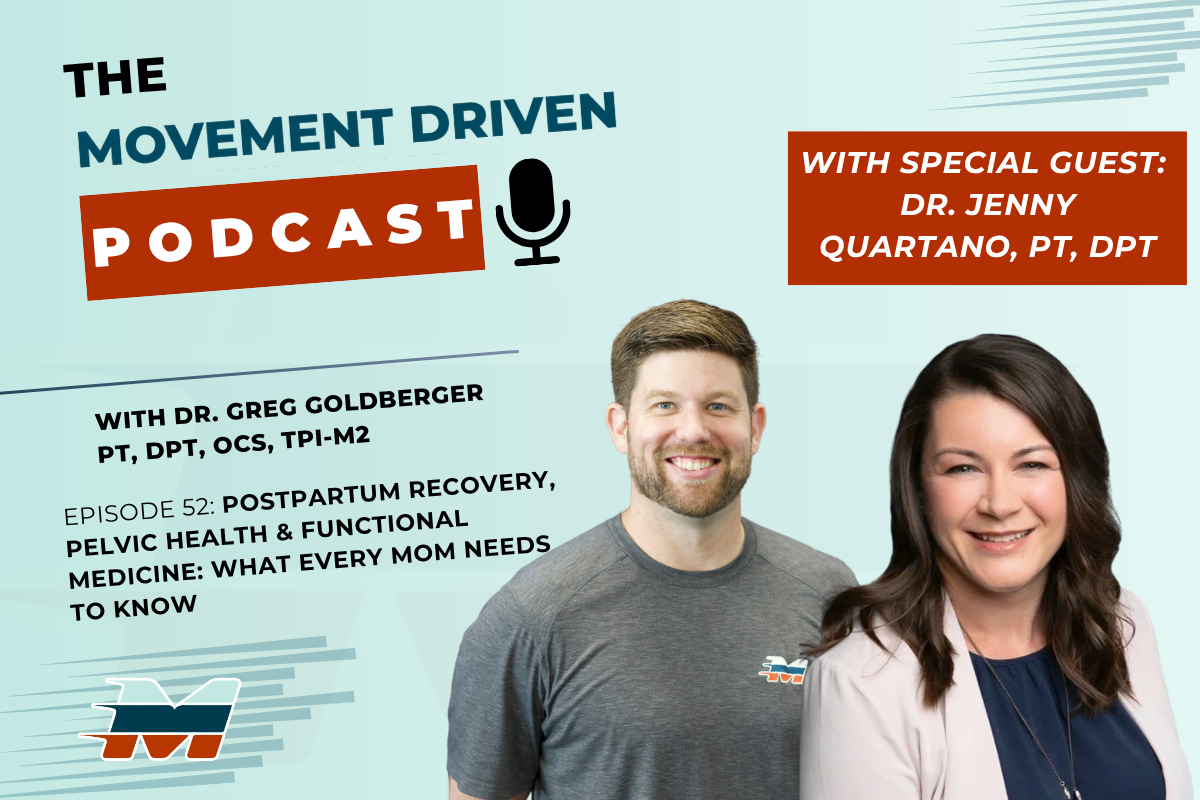
Dr. Greg talks postpartum recovery, pelvic health myths, and functional medicine with Dr. Jenny Quartano, PT, DPT of All Together Wellness.

Football, golf, and running season means more injuries across Jacksonville and St. Johns County. See how Movement Driven helps active adults and athletes train through fall without getting sidelined.
Dr. Greg shares how a patient avoided shoulder surgery after a car accident, and what made the difference this time. Listen now.

Sitting, bending, lifting, even how you sleep — small daily habits can quietly worsen back pain. A Jacksonville physical therapist breaks down what to fix.