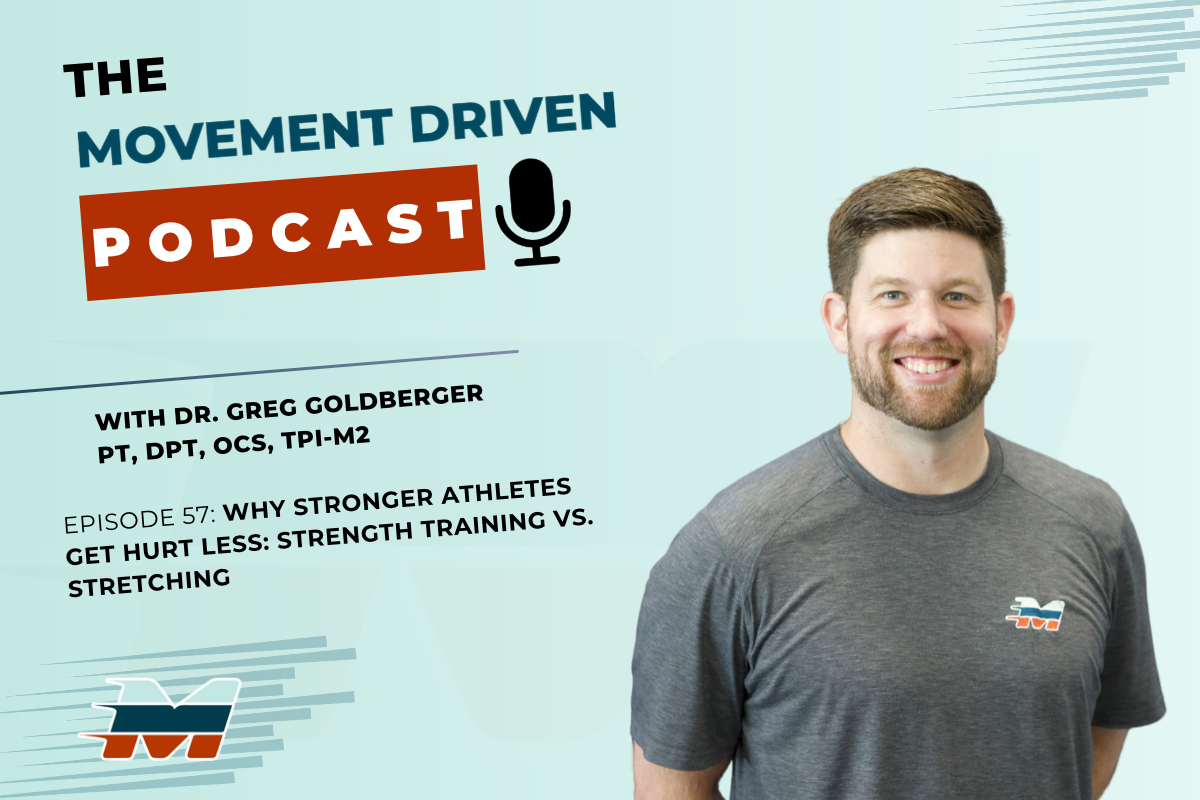
Why Stronger Athletes Get Hurt Less: Strength Training vs. Stretching
How building strength, improving movement control, and adjusting your training during the season can help prepare your body for the activities you love.
You stretch your hamstrings, squeeze in a warm-up, and try to stay consistent with your workouts. But when your running mileage increases or your sports schedule gets busy, the same aches keep showing up.
Could your body need something beyond more stretching?
In this episode of the Movement Driven Podcast, Dr. Greg Goldberger explores the connection between strength and injury resilience. He explains why being flexible is only part of the picture—and how building the capacity to handle your sport’s demands can make a difference.
How Strength Helps Your Body Handle Activity
Running, swinging a golf club, and changing direction on the field all require your body to absorb and control forces.
Dr. Greg explains that muscles play an important role in managing those demands. When strength is lacking, other structures—including tendons, ligaments, and joints—may end up handling more of the load.
Building strength helps prepare your body for repeated efforts and challenging positions. That doesn’t make anyone immune to injury, particularly in contact sports, but it is an important part of developing physical resilience.
The question becomes: does your body have the strength and control to support what you’re asking it to do?
Why Stretching May Not Be the Missing Piece
Feeling tight can make stretching seem like the obvious solution. But Dr. Greg describes a common situation in the clinic: someone believes limited flexibility is causing their problem, yet their assessment shows they already have adequate range of motion.
What they may need is better strength or control within that range.
Flexibility describes how far a joint or muscle can move passively. Mobility also involves your ability to actively access and control movement. Having plenty of range doesn’t necessarily mean you can manage the demands placed on your body in those positions.
That’s why an individualized assessment matters. Some people need substantial mobility work. Others benefit from a program focused primarily on strengthening and movement control.
What Does “Strengthen to Lengthen” Mean?
Strength and flexibility don’t always need separate exercises.
In the episode, Dr. Greg discusses using controlled strengthening movements to challenge muscles through a lengthened position. For someone with tight hamstrings, one example he describes is a light, carefully controlled Romanian deadlift.
The hamstrings lengthen as the person lowers into the movement, then work to bring them back up.
The goal is to develop strength through the available range while also working on movement tolerance and control. The appropriate exercise and range depend on the individual.
For someone who keeps stretching without making progress, this offers a different question to consider: have you trained those muscles to work in the positions you’re trying to reach?
What This Means for Runners, Golfers, and Field Athletes
Different sports create different demands. Dr. Greg connects the episode’s strength discussion to several examples:
- Running: Repeated foot strikes create ongoing demands on muscles and tendons. Strength training deserves a deliberate place alongside running mileage.
- Golf: Rotational strength, mobility, and control help the body manage the demands of the swing, including those placed on the lower back.
- Football and field sports: Strength helps prepare athletes for forceful movements and physical contact, although the unpredictable nature of these sports means injuries can still happen.
A useful program considers the activity, the athlete’s current abilities, and where their preparation may be falling short.
For active adults and athletes in Jacksonville and St. Johns, that might mean looking at more than the painful area when recurring symptoms interrupt training or recreation.
Why Watching You Move Matters
Understanding strength involves more than testing an isolated muscle.
Dr. Greg explains why he includes functional movements in his assessments. Depending on the person’s symptoms and stage of recovery, these might include squats, single-leg bridges, step or lunge variations, and hopping.
These movements help him observe how someone controls their body, handles load, and performs from one side to the other.
The assessment should also match what the person can safely tolerate. Someone with a recent injury or postoperative restrictions may need a different starting point than an athlete who is already training.
The purpose is to connect the examination to the movements and activities that matter to that individual.
Keep Strength Training in the Picture During Your Season
Once practices, games, or longer runs fill the calendar, strength training can become an afterthought.
Dr. Greg discusses why maintaining strength during the season matters—and why that doesn’t mean chasing maximum lifts while your body is already working hard.
Instead, training should account for competition, fatigue, and recovery. In the episode, he describes controlled repetitions and slower lowering phases as tools he may use to challenge muscles while managing the overall training demands.
The goal is to maintain useful strength throughout the season with a plan that supports your activity and recovery.
Listen to the Full Episode
If stretching hasn’t resolved your recurring tightness, your strength workouts keep disappearing during the season, or you want to better understand what your body needs for your sport, this episode is a helpful place to start.
Listen to “Why Stronger Athletes Get Hurt Less: Strength Training vs. Stretching” on the Movement Driven Podcast for Dr. Greg’s discussion of muscle strength, mobility, functional assessments, and in-season training.
Movement Driven Performance Physiotherapy provides one-on-one physical therapy, rehabilitation, and performance care for active adults and athletes in Jacksonville and St. Johns, Florida.
Visit movementdriven.com to schedule an evaluation or book a discovery call with Dr. Greg about your goals.